Fifteen Days, Five Swedish Incidents
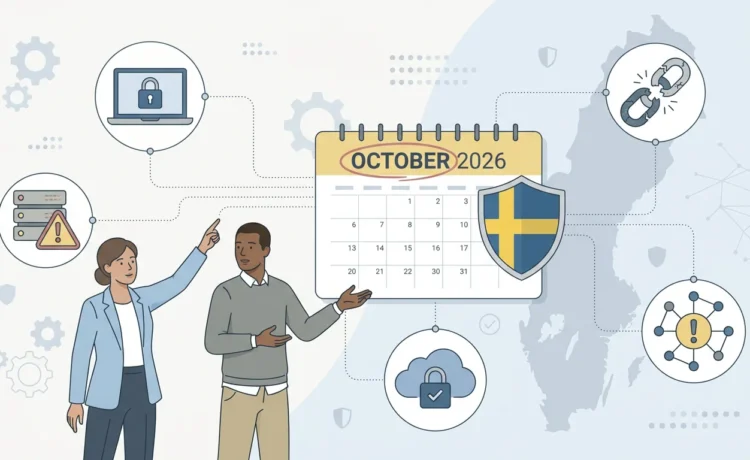
October is Cybersecurity Awareness Month. Halfway through it, Sweden has already handed us a full training syllabus.
On 1 October a municipality in Skåne switched off every system it runs. The same day, new NIS2 rules made MFA and intrusion detection a legal requirement. The next evening a municipal website showed an anime character mocking its owners. Fake 1177 emails started leaving traps in people’s calendars. And a court convicted a healthcare administrator who had opened 129 patient records because she was curious.
None of these needed a zero-day or a state-backed hacker. Each one comes down to a basic control that was either working or wasn’t. All five ran in our Cyber News section.
Key Takeaways
- Five Swedish incidents in the first half of Cybersecurity Awareness Month 2026 trace back to basic controls, not advanced attacks.
- Since 1 October, Sweden’s NIS2 rules make MFA, intrusion detection and board training legal duties.
- The public sector and healthcare were hit hardest.
- The fixes are the basics: offline fallback plans, MFA, access reviews and 24/7 log monitoring.
Five Swedish Incidents at a Glance
| Date | Incident | What Happened | The Lesson |
|---|---|---|---|
| 1 Oct | Svedala ransomware | Every system shut down, care staff on paper | Plan to run without IT |
| 1 Oct | New NIS2 security rules | MFA, intrusion detection and board training became law | The basics are now legal duties |
| 2 Oct | Nyköping website hack | An anime image sat on nykoping.se for about 30 minutes | Know who can publish to your site |
| 5 Oct | Fake 1177 emails | Fake offers, login links and calendar invites | Clean the calendar, not just the inbox |
| 6 Oct | Region Östergötland conviction | 129 patient records opened out of curiosity | Logs catch it late, access rights stop it |
1. Svedala: What Happens When Every System Goes Dark
Overnight into 1 October, an intruder got into Svedala Municipality’s network. The municipality switched off every digital system it runs. E-services stopped and home care staff went back to paper. The chief executive told SVT it looked like ransomware. As of our report on 2 October, no ransom demand had arrived.
The warning signs were on paper. A 2022 KPMG review found essential information security steps had not been taken, and the 2025 annual report listed IT security as a risk. A crisis plan from October 2025 is what kept care running.
Ask yourself: If you pulled the plug tonight, which services would still run tomorrow, and who decides? Under Cybersäkerhetslagen the reporting clock starts too, early warning within 24 hours, notification within 72 hours, final report within a month.
2. New NIS2 Rules: The Basics Are Now the Law
The same day, MCFFS 2026:11 gave NIS2 in Sweden its technical teeth. Essential and important entities must now run intrusion detection on production IT networks and use MFA for administrators and anyone connecting from outside. Logging, DNSSEC, prompt patching and board training are on the list too.
Real-time monitoring is softer. You only have to “identify and handle the need” for it. But on 22 September, IMY fined Miljödata SEK 1.8 million partly for not having it. A decision not to monitor is one your board should sign off on.
Ask yourself: Could your board prove today that it was trained and briefed this year?
3. Nyköping: Half an Hour on the Wrong Homepage
Around 20.30 on Friday 2 October, visitors to nykoping.se saw L from the anime Death Note and a taunt, imagine getting hacked in 2026, you should fix this. By about 21.00 it was gone. In its statement after the incident, the municipality did not say how the page was changed.
Catching it within half an hour on a Friday night is good monitoring. The bigger worry is quieter, anyone who can post an image can also change a phone number or a payment link.
Ask yourself: Who can publish to your public website, from where and with MFA? A penetration test of your CMS and hosting answers that before an attacker does.
4. Fake 1177 Emails: The Trap That Survives Deletion
Fraudsters are sending emails in the name of 1177, Sweden’s national healthcare service, offering discounts, asking people to log in or dropping invitations into their calendars. According to 1177’s own guidance, it never sends clickable login links, apart from video appointments or surveys for patients with an ongoing care contact.
The calendar part is what IT teams should worry about. Barracuda researchers found the entry often stays in the calendar after the email is deleted or quarantined. Sent to a work address, the lure sits next to real meetings.
Ask yourself: When your email filter quarantines a message, does the calendar entry go with it? Add this scenario to your security awareness training.
5. Region Östergötland: Six Months Before Anyone Noticed
Between November 2022 and May 2023, an administrator at a psychiatric clinic in Linköping opened 129 patient records belonging to about 100 people. She told the court she was curious. On 6 October 2026 she received a conditional sentence and 36 patients share SEK 288,000 in damages.
The region’s log checks caught her but only six months in. As of October 2026, three other Swedish healthcare workers have been convicted of similar snooping this year. In every case the records had already been read before anyone noticed.
Ask yourself: Pick one role. Of the records it opened last month, how many had a real work reason behind them? It works in any sector holding sensitive data.
What the Five Have in Common
Three of the five hit the public sector and two touch healthcare. Municipalities and regions hold sensitive data, run services people cannot do without and often have small IT teams. It matches the wider picture: in ENISA’s Threat Landscape 2026, public administration was the most targeted sector in the EU, at 32% of recorded incidents.
The other pattern is time. Nyköping was caught in 30 minutes. Östergötland took six months. As of our 2 October report, Svedala had not said how the intruder got in. The difference is mostly whether someone watches the logs around the clock. That is the job a 24/7 MDR and SOC service is built for.
A Short Awareness Month Checklist
If you only do six things this October, make it these:
- Write down which services must run if IT goes offline, and test the paper fallback once.
- Confirm MFA covers every admin account and every external connection, including suppliers.
- List everyone who can publish to your website and remove the accounts nobody uses.
- Check that quarantined emails also lose their calendar entries.
- Review one role’s access to sensitive records against actual work need.
- Book the annual security briefing for your board before the year ends.
Frequently Asked Questions
When is Cybersecurity Awareness Month?
Every October. In Europe it runs as the European Cybersecurity Month, supported by ENISA and the European Commission. It is a good moment to test your basics, refresh staff training and brief your board.
What is MCFFS 2026:11?
MCFFS 2026:11 is the Swedish regulation that sets out the security measures and management training NIS2 entities must have in place under Cybersäkerhetslagen. It was issued by Myndigheten för civilt försvar (MCF) and came into force on 1 October 2026. Read the regulation (PDF, Swedish).
What do Sweden’s NIS2 rules require from 1 October 2026?
MCFFS 2026:11 requires essential and important entities to run intrusion detection on production IT, use MFA for admin and external access, log and analyse access attempts, patch promptly and train management. Our NIS2 compliance page covers the full scope.
How can I tell if a 1177 email is real?
A real 1177 email tells you a message is waiting, asks you to log in at 1177.se and contains no clickable link. Offers, discounts, login links and calendar invites are fake. Delete the email and the calendar entry. See 1177’s own guidance.
Awareness Is Only the First Step
Awareness Month works best when it ends with something changed, not just something read. Pick one question from this article and answer it for your own organisation before 31 October.
If you want a quick starting point, our free domain breach checker shows which of your staff credentials are already circulating online. For anything bigger, book a briefing. Our Cyber News section covers Nordic incidents as they happen.
This post is also available in:
 Svenska