Executive Summary
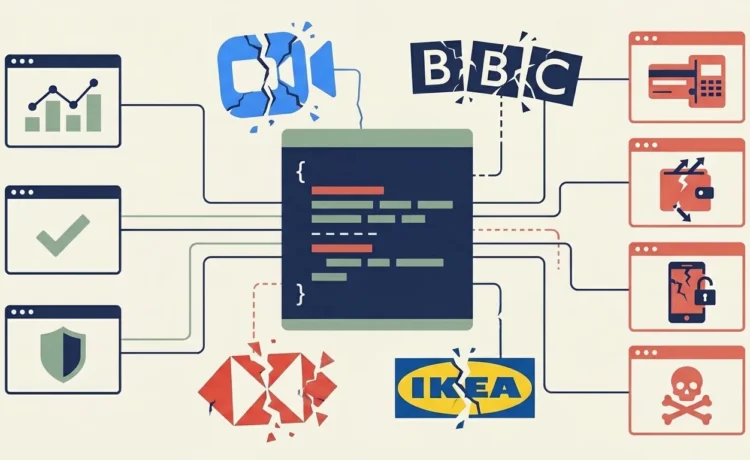
An Optimizely supply chain attack on 16 November 2026 turned its Web Experimentation snippets into a malware channel for visitors to 178 organisations’ websites, among them Zoom, the BBC, HSBC and IKEA. Researchers at Report URI found the malicious code in 188 of the 1,611 snippets they checked. It swapped cryptocurrency wallet addresses, skimmed card details, stole cookies and screenshots and pushed iPhone users towards the Coruna and DarkSword exploit kits. Optimizely says an unauthorised party exploited a vulnerability in Experimentation and that the flaw is fixed. Finland’s S-Pankki, Betsson, Danish unemployment fund AKA and Norway’s Flytte.no are on the victim list. No attacker has been named.
How the Code Got Into Optimizely Snippets
Optimizely Web Experimentation lets teams change a live website without a code release. Each customer loads a JavaScript snippet from Optimizely’s CDN with an optional field, Project JavaScript, that runs on every page.
According to Report URI, the attacker wrote a loader into that field and left the rest of each snippet untouched. The file still came from cdn.optimizely.com with Optimizely’s own certificate. The first injection it recorded was in the BBC’s snippet at 04:21 UTC. By early evening its sweep counted 186 infected snippets. The loader came in three forms: a plain script tag pointing at 1688360.cc, the same address hidden in base64 and a full inline copy that ran through eval if that domain was blocked.
Optimizely’s status page says an unauthorised party “exploited a vulnerability in Experimentation” to add the code to some customer projects. It says it has also secured affected user accounts. A company spokesperson has said the flaw sat in the Experimentation account signup flow. Optimizely hasn’t explained how a signup bug gave write access to existing projects belonging to unrelated customers.
Cards, Cookies and iPhones
The payload was rebuilt 26 times during the day. A card skimmer, added at 13:43 UTC, read card number, expiry date and CVV from forms that sites built themselves. Report URI says cards typed into hosted payment frames from providers such as Stripe or Adyen were out of reach. The script also took cookies not marked HttpOnly and rendered screenshots of pages where it swapped a wallet address.
On iPhones and iPads it loaded Coruna for iOS 13 to 17 and DarkSword for iOS 18. Both are web-delivered exploit chains; the kit’s own comments say iOS 18.7.3 and iOS 26.3 onward are patched.
By 19:25 UTC the attacker’s wallets had received about $7,040. How many cards reached the attacker is unknown.
Nordic Names Among 178 Organisations
Report URI’s list includes S-Pankki (s-pankki.fi), the gambling operator Betsson, the Danish unemployment fund AKA (aka.dk), the Norwegian moving-comparison site Flytte.no and IKEA’s home-design client. Banking and finance was the largest sector with 32 organisations.
The platform at the centre of the Optimizely supply chain attack has Swedish roots. Optimizely took its current name after Stockholm-based Episerver bought it in 2020.
Zoom said it had disabled Optimizely across its production environments as a precaution.
Why Most Security Policies Didn’t Stop It
A Content Security Policy is a browser header that limits which scripts a page may load and where it may send data. Report URI crawled 256 hosts of affected organisations: 68 had no policy and only 24 blocked the payload. Allowing cdn.optimizely.com was useless because the code arrived from that host. At HSBC the policy blocked track.js but permitted eval. The inline copy ran anyway. Optimizely’s own CSP guidance says some features, including audiences with custom JavaScript conditions, don’t work unless ‘unsafe-eval’ is allowed.
Optimizely hasn’t said how many projects were altered or how long the vulnerable path was open. No group has claimed the attack. Report URI says the same actor’s injector first showed up on Turkish sites on 17 September and that an earlier wave from 13 November ran through Kissmetrics, StorifyMe and Minute Media scripts.
A GDPR Clock for the Sites That Served It
Optimizely fixed the flaw. The companies whose pages served the code are still the data controllers for their visitors. For S-Pankki, AKA and the other EU names, skimmed cards and session cookies are personal data that Report URI’s view of the attack can’t account for. GDPR Article 33 gives a controller 72 hours from awareness of a personal-data breach to notify its regulator. Danish ad-tech firm Adform faced the same test this summer: its tracking script swapped wallet addresses on 27 July 2026 and it notified Datatilsynet on 5 August.
References
- World’s Largest Brands Infected With Malware Via Optimizely
- Web Experimentation Security Incident
- Update your site’s Content Security Policies
- Episerver and Ektron Combine to Create Most Complete Digital Experience Platform in the Cloud
- Security Incident: Company Update
This post is also available in:
 Svenska