Executive Summary
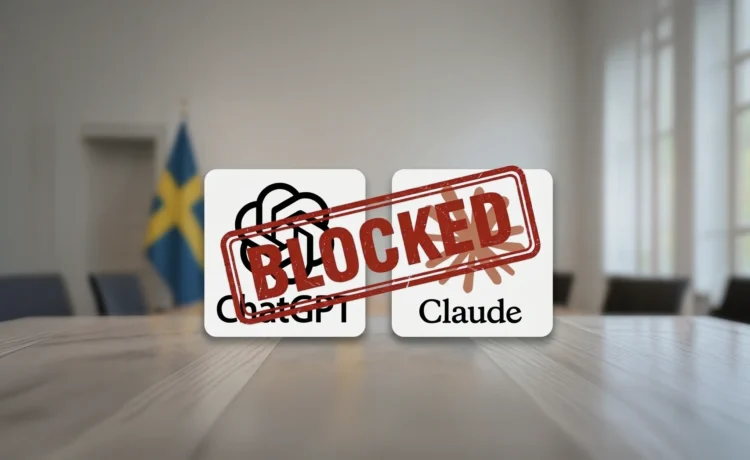
Sweden’s Government Offices (Regeringskansliet) began to block ChatGPT and Claude on staff work computers on 26 October 2026, when the browser versions of both AI services stopped loading. Staff are pointed to approved tools instead. Microsoft Copilot is open to every employee after a security review. The ChatGPT and Claude language models stay reachable through Intric, an AI platform the Government Offices procured in July 2026. Digitalisation director Mikael Wettercrantz warned staff that AI services used without an agreement can harm information security. No published statement links the decision to a leak. The Swedish Tax Agency and the National Board of Institutional Care (SiS) already block AI services.
Browser Access to ChatGPT and Claude Ends, the Models Stay
In a written statement, the Government Offices said the browser interfaces of ChatGPT and Claude would no longer be reachable from its work computers from 26 October. Staff keep both language models inside Intric, it added.
Intric is a Stockholm company whose platform lets organisations build AI assistants on their own data. It announced in July 2026 that it had won the Government Offices’ procurement for a one-year contract with an option to extend by a further year. Intric says the platform runs on Swedish infrastructure, as a cloud service or on premises. Early reporting called it a platform the offices built themselves, their statement names Intric.
Copilot stays approved for all staff. Its security settings were raised after a review. What changed hasn’t been disclosed.
A Warning on the Intranet
Wettercrantz declined an interview request. On the staff intranet he wrote that using AI services without an agreement can have “consequences for our information security”, according to a published report based on internal information.
The offices had already restricted DeepSeek.
500 Staff Trained on Generative AI in 2025
The block comes after a year of AI pilots inside the Government Offices. Its 2025 yearbook, published in July 2026, says pilot projects on generative AI ran during 2025 and that more than 500 employees took training on generative AI and how to use it in everyday work. It also records that an AI coordinator was appointed in the Prime Minister’s Office when work began on a new AI strategy. That section does not name the AI services staff were using.
Tax Agency, SiS and an Audit at Trafikverket
The Government Offices is not alone. The Swedish Tax Agency (Skatteverket) and SiS have introduced blocks, according to the same report. The Swedish Enforcement Authority (Kronofogden) is preparing a position. At the Swedish Transport Administration (Trafikverket), an internal audit earlier in 2026 found widespread and risky use of about ten AI services. The auditors pointed to problems with both the sensitivity of what staff typed in and how they handled the answers.
Public bodies have had national guidance since 21 January 2025, when the Agency for Digital Government (Digg) and the Swedish Authority for Privacy Protection (IMY) handed over guidelines on generative AI covering management and accountability, cybersecurity, GDPR, ethics, labour law and procurement. IMY’s GDPR report of 5 February 2025 states that the organisation is the controller for its own use of generative AI and that the AI supplier is, as a starting point, a processor.
Staff Numbers and Settings Not Disclosed
The Government Offices hasn’t said how many employees have Intric access or which Copilot settings were tightened. It is not known when the Tax Agency and SiS blocks began or which services they cover. No authority has said whether official information was entered into the consumer services before the block.
Same Models, Different Contract
The decision to block ChatGPT and Claude removed no model. It removed the route that runs outside a contract. The models its staff can still reach sit inside Intric, a platform bought under a procurement in July 2026, three months before the browser block. IMY’s reading explains the order, the organisation is the controller and the supplier a processor. A browser session on a consumer service has a supplier but no agreement with it. That is the gap Wettercrantz named on the intranet.
References
- Regeringskansliets årsbok 2025
- National guidelines for generative AI in public administration are launched
- GDPR vid användning av generativ AI
- Riktlinjer för generativ AI
- Intric Wins Procurement with the Government Offices
This post is also available in:
 Svenska